A core essay on sacred geometry as threshold and passage rather than final metaphysical doctrine.
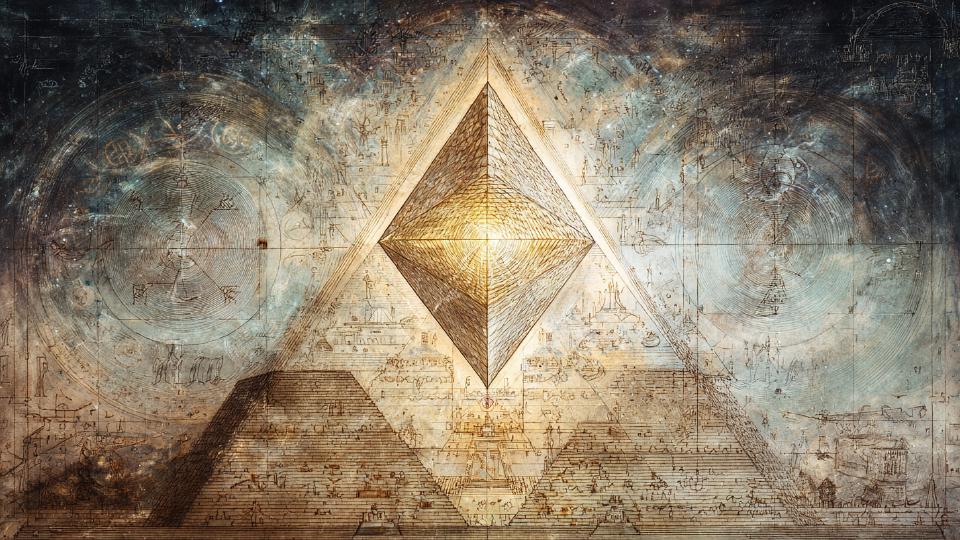
Operative vs. Explanatory
Many people who search for divine geometry or the Platonic solids carry a clear expectation: these perfect forms must represent the highest metaphysical truths, the hidden blueprints of reality itself. Cubes, tetrahedra, dodecahedra are often treated as final keys.
When Hermetic, Chaldean, and alchemical sources are examined closely, however, a different pattern emerges. The Platonic solids are present, but they are rarely central. They do not dominate visions, rituals, or ascent narratives. They appear briefly, indirectly, or not at all.
That absence is not an omission. It is a signal.
The Platonic solids are not the summit of sacred geometry. They function as thresholds.
The Door That Started Everything
The sequence described here did not arise from philosophical speculation or abstract geometry. It began with a glyph.
On a door, unmistakably marking a boundary, a sign appeared. Three aspects proved decisive: its existence, its role, and its effects.
The specific form of the glyph is not reproduced. The argument does not depend on it, and there is little value in circulating a design detached from its context.
At first encounter, the mark appeared simple, even minimal. Over time, however, it initiated a long chain of experiences, visions, and recognitions that only later arranged themselves into coherence. In retrospect, its nature became clear. This was not decorative geometry. It was functional.
A Geometric Threshold
With time, the type of geometry at work became intelligible without reference to a specific shape.
What mattered was not a figure, but a condition: opposing tendencies held in equilibrium around a point of stability.
When such a condition is expressed in a reduced or planar way, what remains is not an image but a logic. The glyph did not teach geometry as a subject. It encoded a state, one that could be recognised, entered, activated, and eventually surpassed without ever being rendered as a diagram.
Why It Appears as a Glyph, Not a Solid
Late antique theurgic writers provide language that clarifies this distinction.
Iamblichus, drawing on the Chaldean tradition, describes sunthemata: tokens and signs sown throughout the cosmos and implanted in souls as triggers of recollection and ascent. In this view, a sign is not primarily an idea to be interpreted. It functions instead as a point of contact through which higher causes may act.
This distinction explains why an initiating mark may appear at a threshold without becoming a philosophical diagram. The sign belongs to operation rather than cosmography.
In many Hermetic and alchemical contexts, elaborate solid geometry serves an explanatory role. It describes order more readily than it carries power or instruction. Glyphs, by contrast, belong to operative use. They may be placed at thresholds, repeated without commentary, and treated as tokens rather than demonstrations.
A glyph may be inscribed on doors, seals, and boundaries. It may mark passage. It may function as a sunthema that elicits a vertical response.
The location is decisive. A door is not a place. It is a transition.
This is not merely symbolic. In the Greek magical papyri, doors and latches function as real operational points. Actions are performed at thresholds, progress is tracked from outside to latch to entry, and seals operate as binding constraints. In the same late antique milieu that shaped theurgic language, the threshold already functioned as a technology.
The glyph does not declare the presence of a particular solid. It announces a condition: opposites are balanced, and passage is permitted.
Fixation Rather Than Union
One feature of the glyph clarified its function.
It indicated that circulation had found rest, that movement had discovered a point capable of holding it. In alchemical terms, this corresponds to fixation following volatility. The result is not merely union, but union that can endure.
Many symbols suggest balance. Far fewer indicate that balance has become habitable.
This helps explain the sequence of later developments. The glyph appeared first because it marked the precondition for everything that followed.
The Octahedron’s Echo After the First Conjunction
Before any sustained high noetic phase, understood here as direct apprehension of intelligible structure rather than imaginal or discursive mediation, there was an earlier period in which a single solid recurred as an interior template.
In practice, this did not reflect adherence to Platonic cosmography. It functioned as a discipline of balance, a way to hold attention within structured tension without collapse into vagueness.
Later, after what may reasonably be described in alchemical terms as a first conjunction, an initial union sometimes glossed as a preliminary stone, the same form returned with a different character.
It did not return as an object of contemplation in its own right, nor as proof of the divinity of solids. It returned as an echo: the reappearance of a balancing condition at the moment when opposites had been brought into relation and required a stable mode of circulation.
In this sense, the octahedral motif functions as a transitional operator. It belongs neither to architectural ascent nor to the later dominance of pure symmetry. It appears when the work demands equilibrium capable of movement, balance with exchange, before a different regime asserts itself.
This is offered as experiential report accompanied by interpretation. In operative contexts, a solid may recur not because it is ultimate, but because it provides the appropriate constraint for a particular phase. When the phase concludes, the form recedes.
The Missing Middle Layer: Pyramids, Ziggurats, and the Geometry of Ascent
Discussion of Platonic solids often falters because an intermediate layer is overlooked.
Within the Chaldean and theurgic orbit, a concise warning appears: do not deepen the plane. Read through the Pythagorean unfolding from point to line to plane to body, this cautions against allowing intelligible structure to sink into volumetric extension. In this light, pyramids acquire renewed relevance, as they are often treated as the first true body, the moment when the plane acquires depth.
Most sacred architecture is not constructed from Platonic solids. It is built from gradients that encode ascent, compression, and threshold.
For this reason, pyramids and ziggurats recur across cultures more frequently than dodecahedra. A pyramid gathers multiplicity into unity under constraint. It presumes height, effort, and gravity. Ascent remains spatial, even when symbolically charged. The ziggurat makes the same logic explicit by dividing ascent into stages, externalising a ladder of states.
This architectural family bridges three registers: geometry as cosmic stability, geometry enacted as ritual ascent, and geometry experienced as inner transition.
Its message is consistent. Geometry is not only form. Geometry is passage.
The Polygon Ladder in the Fortress of Mind
At the stage described as high noetic, one experience presented itself as explicitly geometric without becoming architectural.
Late antique ascent models and mystery traditions often describe graded passage through concentric structures and layered doors. The experience reported here parallels that logic in sharpened form, replacing mythic scenery with regularity and precision.
This account is offered as vision rather than doctrine. No claim is made that any text prescribes a fixed polygonal sequence.
The pattern consisted of concentric, uniform polygons that simplified as they ascended. Many sided regular forms yielded to fewer sides, culminating in perfect circularity.
Read metaphysically rather than visually, the sequence depicts intelligibility concentrating. Structured plurality gives way to universality, and finally to identity without articulation.
The significance lies not in polygons as doctrine, but in their function as a bridge. Articulated form condenses toward symmetry, preparing the transition to spherical dominance.
From Polygon to Sphere
When symmetry becomes dominant, geometry does not disappear. Its mode changes.
Hermetic cosmology already accommodates this shift. In the Poimandres discourse, cosmic order is expressed through rulers, harmony, and spheres, and through a boundary that must be crossed. A movement toward spherical language is therefore doctrinally consistent.
The sphere serves as an emblem not because it represents an ultimate shape, but because it removes privilege. No face is primary. No direction is favoured. No boundary behaves as a wall.
At this stage, structure persists as relationship and resonance rather than enclosure. Geometry no longer organises ascent. It emerges as a consequence of participation. Lattices and fields become more accurate descriptions than polyhedra.
The movement is not from many shapes to no shape. It is a movement from architectural geometry, which presumes orientation and effort, to ontological geometry, where order is participated rather than climbed.
Why the Platonic Solids Fade From View
This perspective resolves the initial puzzle of the diminished role of Platonic solids in higher Hermetic and theurgic material.
Their importance is not denied. Their scope is limited.
Platonic solids describe stable equilibrium states of nature considered in itself. They articulate how matter coheres under fixed ratios. They belong to demiurgic order, the crafting of a stable cosmos.
Ascent, however, is concerned with transformation rather than stability. When soul and intellect are fully engaged, fixed ratios prove insufficient. Static symmetry yields to dynamic relation. Geometry shifts from enclosure to field.
For this reason, solids may appear briefly around moments of balance or conjunction and then recede as experience moves toward relation, gradient, and symmetry. The withdrawal is phenomenological rather than ontological. Articulated form falls from view while its ratio logic persists as tensional balance within an emerging field.
Post Noetic Geometry Still Has Structure
The fading of solids does not imply the loss of order.
Beyond the noetic threshold, structure continues in another register, expressed as spheres rather than polyhedra, lattices rather than walls, and fields rather than rooms.
This is geometry without architecture, ordering without enclosure.
The initiating glyph marks the final moment at which geometry may appear publicly as a sign on a door. Beyond that point, geometry is encountered primarily as mode rather than figure.
Platonic Solids and Their Uses
Platonic solids are often treated as divine primitives, perfect forms capable of grounding certainty about reality. Within Hermetic, Chaldean, and alchemical contexts, this expectation requires adjustment.
Their principal value lies in their function as constraints rather than culminations.
They provide language for coherence, for imagining elements as stable enough to host life, fate, and ritual. This explains their prominence in explanatory registers. In operative settings, a solid may also serve as a temporary interior discipline, a clean container for attention that trains balance and proportion without encouraging fantasy. In this sense, the value lies less in divinity than in honesty of perception.
At certain moments, a form may reappear as a transitional operator. The octahedral motif returns when equilibrium capable of circulation is required, and withdraws when conditions change. This is characteristic of operative forms. They appear when appropriate and vanish when their function concludes.
The claim, therefore, is not that Platonic solids lack importance. It is that their importance is phase specific. They stabilise perception early, and reappear later only when a particular constraint is required. Doctrine supplies vocabulary and limits. Experience supplies the data.
The door opens. The initiating glyph remains behind.
Working: Using Form Until It Is No Longer Needed
What follows is neither ritual nor visualisation nor symbolic drama. It is a constraint based attentional working intended for solitary practice. It assumes seriousness, restraint, and the capacity to cease when fixation arises.
Purpose
The aim is to employ geometric form only so long as it stabilises attention, and to release it deliberately when its function is fulfilled. This establishes a correct relationship to form: use without attachment, structure without idolatry.
Phase I: Establishing Constraint
Begin from a settled attentional state. Imagery is unnecessary.
Introduce a single constraint: the maintenance of balanced opposition without preference.
This may be framed abstractly as equal tension between ascent and descent, expansion and contraction, activity and rest. The task is not to imagine a shape, but to maintain equilibrium without oscillation.
If a form arises spontaneously as a means of holding this balance, it may be allowed without elaboration or refinement. The form is not the object of attention. It functions only as a container that prevents drift.
Remain until circulation stabilises. Attention moves without spilling. Tension remains without strain. This is fixation with breath rather than stillness by suppression.
Phase II: Circulation Within Balance
Once equilibrium is stable, movement may occur within it. Attention may circulate, invert, or exchange poles while the overall balance remains intact. If imbalance appears, the constraint is re established immediately.
Intensification is neither required nor sought. Durability rather than sensation marks success.
Phase III: Deliberate Release of Form
When balance sustains itself without conscious reinforcement, the form is released.
This release is explicit. It is neither passive fading nor active suppression. The constraint is withdrawn.
If balance collapses immediately, the release has occurred too soon. The constraint is restored and the process repeated.
If balance persists without reference to form, geometry is not reintroduced. Ordering is allowed to continue without enclosure.
Phase IV: Non Spatial Ordering
At this stage, structure may still be present, but it no longer appears as spatial, architectural, or imaginal. Ordering manifests as relation, symmetry, or resonance rather than figure.
Naming and symbolic stabilisation are avoided. Any reintroduction of form returns the work to an earlier phase.
Closing Condition
The working ends deliberately. Lingering is avoided. The aim is correct contact followed by return.
This practice does not advance through repetition. It trains discernment: recognition of when a form is required and when it must be set aside.
Forms that cannot be released were never instruments. They were idols.