Visionary Operations
These scenes are treated as operations rather than private reverie. Each station is approached in terms of what it does: what kind of order it discloses, what function it performs, and how agency shifts from technique and testing toward alignment, conveyance, recognition, and settled authority.
The Rotating Platform with Crossing Arches
After the extended passage through the void, arrival occurs at a round platform, isolated or suspended within an undefined expanse. The platform turns slowly on its axis. The motion is steady and calm, giving orientation rather than vertigo.
At its center stand crossing arches that form a precise geometric nexus. They do not read as ornament. They read as a working intersection, a place where directions meet and attention is gathered. Across the floor, subtle reddish patterning appears, deliberate and controlled. The red is perceived as functional, not affective.
Within or above the crossing arches rests a small elevated point, distinctly charged with concentrated energy. This point functions as the true center. From here, translation occurs. The platform is not a destination and does not invite lingering. It behaves like a transfer station. From the central elevation, movement resumes and the scene yields to another domain.
The overall tone is structural. Rotation, color, and geometry cooperate to stabilize what has already been integrated and to set it in the correct orientation for what follows.
This station functions as a consolidation and redirection node, where forces already unified are briefly balanced, oriented, and released toward their next mode of expression.
Circular motion is repeatedly used in Hermetic and alchemical languages to signal stability without stagnation: the heavens in their courses, the return of a thing to itself, the circulation that refines without dispersing. Read in that light, the rotating platform feels less like scenery and more like an image of the work held in motion while remaining fixed in place. The crossing arches add a second principle: intersection and measure, the meeting of lines that otherwise would not touch. Together, rotation and nexus suggest a station where what has been integrated is brought into exact alignment before translation proceeds.
Entry into the Watery Expanse and the Act of Praise
Transition leads into a watery, mist-filled realm. The environment is expansive and fluid, lacking firm boundaries or fixed landmarks. Water and vapor dominate perception, creating openness rather than threat.
Presence is situated within a boat. There is no act of steering. The boat moves of its own accord, while awareness remains attentive and upright. As movement unfolds, praise of the creators arises. It comes unforced, without prompting, obligation, or any sense of performance.
The boat drifts between rocky formations that narrow the passage. At first the channels feel confining and sharpen attention. Over time, constriction gives way to continuity as the boat proceeds naturally through the terrain.
The water supports rather than resists. Trust is present without passivity: alert presence without control, surrender without collapse.
Here, praise functions not as petition or devotion, but as ontological resonance: the completed circuit giving voice to its own alignment.
Hermetic texts repeatedly treat praise as the native activity of mind when it is in tune with its source. In the Secret Sermon on the Mountain, the hymn of rebirth is not framed as a request for favors, but as the voice of a purified power breaking into song. Praise, in that register, belongs to participation rather than bargaining. The boat carries the same lesson: not the loss of agency, but its refinement. Movement is carried, not because agency is absent, but because agency has shifted from steering to alignment.
The Hidden Cavern of Golden Light and the Assembly
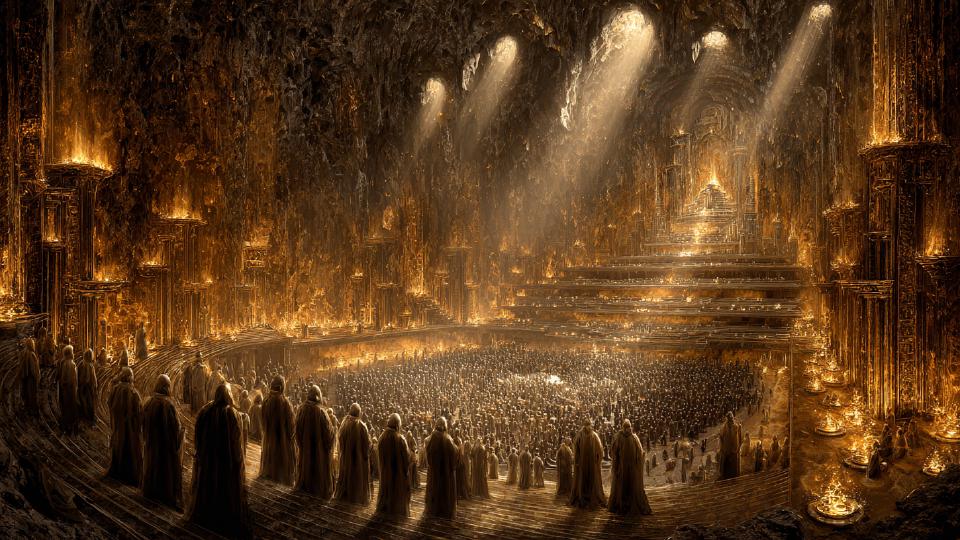
Ahead, an illuminated cavern opens. Upon entry, the interior reveals itself as vast, far exceeding first impressions. The space is suffused with golden light, steady and pervasive rather than dazzling.
Within the cavern are beings bearing a golden appearance or clothed in gold. They do not present as a sequence of individuals but as an assembly, a host that extends deeply into the space and gives a sense of continuity and order. The cavern carries a quality of hiddenness, as though inaccessible to those lacking preparation or alignment.
A structure of responsibility is perceptible. There is a main assembly, and beyond or above it, others positioned according to greater scope or function. This stratification does not feel like social hierarchy. It feels organizational, reflecting degrees of responsibility rather than rank.
The atmosphere is solemn without being oppressive. Nothing here reads as spectacle. There is no testing, interrogation, or display. The scale conveys legitimacy rather than grandeur.
This encounter presents a functional order rather than a ceremonial scene, emphasizing belonging by capacity rather than by favor.
The presence of many beings at this stage can seem surprising if the intelligible is imagined as solitary. Late antique sources describe something different. Unity at the summit does not erase multiplicity beneath it; it gathers it into ordered degrees of function. Iamblichus distinguishes Gods, archangels, angels, daimones, heroes, and souls by the quality and stability of their illumination, and he notes that superior manifestations can be accompanied by an abundant multitude, not because reality fragments, but because power unfolds in orders. Hermetic texts likewise speak of a choir of gods and blessed ones to which the mind-led soul is guided. Read in that light, assembly signifies jurisdiction and order, not regression into astral imagery.
Descent of the Central Figure and Recognition
From within the golden assembly, one central male figure becomes distinct. He moves forward and descends toward the one who has arrived. The movement is measured and unambiguous.
Kneeling on one knee occurs instinctively. The gesture is not demanded or enforced. It arises naturally as recognition rather than submission.
No explicit commands, tasks, or instructions are delivered. Instead, a clear understanding is imparted: the work no longer concerns missions, assignments, or outward achievements. Attention is now directed toward development of the self itself.
The exchange is brief yet decisive. It conveys continuation without outlining a path. It bears finality of recognition without implying closure.
This moment signifies acknowledgment of readiness and alignment, not initiation into further labor.
What is striking is not a new command, but the absence of one. The descent conveys recognition without conscription. This matches a recurrent principle in the tradition: once decisive transformation has been accomplished, instruction becomes less verbal and more ontological. The work turns from external accomplishment to inward consolidation, not as retreat, but as the condition for any later action to be lawful and proportionate.
Bestowal of the Golden Sceptre
Following recognition, a golden sceptre is given. It takes the form of a wand with a smooth, rounded head, complete and unbroken in design. The object carries an active presence, often described simply as “magic,” but without spectacle.
The sceptre feels naturally attuned. It does not register as foreign. It is experienced as an extension of mind and will, already aligned rather than requiring conquest or mastery.
There is no impulse to test, wield, or apply it outwardly. Its presence alone confirms authority. That authority does not express itself as command or domination, but as settled capacity.
The sceptre is understood as expressive rather than directive. It signifies the ability to stand as an axis through which order manifests, rather than as an instrument for accomplishing discrete tasks.
This bestowal marks the transition from task-oriented operation to sovereign presence, where influence proceeds through being rather than doing.
Regalia motifs in Hermetic and alchemical literature often mark a change in mode: from instrumentality to settled authority. A sceptre, unlike a sword, does not primarily separate; it stabilizes and signifies governance. The rounded head reinforces wholeness and completion. The notable detail is restraint: there is no compulsion to wield the object outwardly. The emphasis remains on attunement and presence, consistent with the idea that at higher registers, efficacy is expressed by what a being is, not by what it attempts.